
More Information
Submitted: September 28, 2026 | Accepted: October 07, 2026 | Published: October 09, 2026
Citation: Paulson BN, Hayes AL. Cultivating Career Longevity: How to Apply the Resiliency Wellness Model to Organizational Retention Strategies. J Addict Ther Res. 2026; 10(1): 15-23. Available from:
https://dx.doi.org/10.29328/journal.jatr.1001035
DOI: 10.29328/journal.jatr.1001035
Copyright license: © 2026 Paulson BN, et al. This is an open access article distributed under the Creative Commons Attribution License, which permits unrestricted use, distribution, and reproduction in any medium, provided the original work is properly cited.
Keywords: Behavioral health; Burnout; Employee retention; Organizational wellness; Resiliency

Cultivating Career Longevity: How to Apply the Resiliency Wellness Model to Organizational Retention Strategies
Brian N Paulson1 * and Amy L Hayes2
1University of South Florida, USA
2Spring Arbor University, Northwestern College, USA
*Corresponding author: Dr. Brian Paulson PhD., LMHC, LMFT, MCAP, CGAC, Visiting Professor of Instruction, University of South Florida, Child & Family Studies, 13301 Bruce B Downs Blvd., MHC 2312, Tampa, FL 33612-3807, USA, Email: [email protected]
The behavioral health field currently faces a severe retention crisis exacerbated by occupational stressors and systemic exhaustion. High turnover rates continue to cause more instability for organizations and the vulnerable populations they serve concerning continuity of care. As the workforce continues to burn out, the ones that stay are inundated further, increasing the unsustainability. This report introduces qualitative data that aligns and supports the Resiliency Wellness Model, a strategic framework positioning wellness as a solution that is achievable with administration focusing on three specific pillars to mitigate staff attrition, reduce emotional exhaustion, and reverse a depleted sense of personal accomplishment among the behavioral health workforce. This brief provides systemic steps to create an organizational plan that focuses on the factors noted by clinicians to better help and aide them in their development of resiliency to burnout and compassion fatigue that continue to attribute to the low numbers of behavioral health workers.
The behavioral health field currently faces a severe retention crisis fueled by occupational stress. The authors observe that high turnover rates directly harm the continuity of care for vulnerable populations and individuals with mental illness [1,2]. As Vilardaga et al. [3] illustrate in their research on addiction counseling workforces, exhaustion is a systemic issue requiring immediate organizational intervention. Burnout rates among applied psychologists and mental health providers have reached concerning levels across the field [4]. The authors approach this issue not as a failure of individual resilience but as a structural deficit within the healthcare system [5,6]. This requires a comprehensive plan designed to guide future organizational change and policy development.
The concept of burnout involves emotional exhaustion and a significantly reduced sense of personal accomplishment. These debilitating symptoms manifest daily in clinics and hospitals. According to Maslach (1982) [7], this syndrome presents a severe threat to clinical efficacy and workforce stability. Research specifically focused on addiction counselors confirms that emotional intelligence deficits accelerate the onset of burnout in this population [8]. Acknowledging the severity of the issue through empirical data is the first step toward institutional healing. The authors implore clinicians and supporters of the field alike to rethink exactly how clinical environments are structured and how they can be enhanced with intentionality that benefits the workforce and the profession as a whole.
The authors used a narrative approach so as to shift the burden of wellness away from the individual clinician and place it on the organization. Highly talented professionals frequently leave the field prematurely because they lack basic structural backing and support [1,9]. As Knight et al. (2012) [10] point out, organizational issues and decreased occupational backing are primary contributors to this mass exodus. Counselor turnover has measurable downstream consequences for the clients these professionals serve, including reduced treatment retention and poorer recovery outcomes [11]. It is a shared professional responsibility to build environments that sustain clinical energy over the long term. Organizations need to create systems where self-care is genuinely possible and encouraged by leadership.
The data shows that resilience is an active process that must be sustained by the workplace itself [12,13]. The authors expand upon empirical findings to build a highly practical framework for behavioral health leaders. As Masten (2018) [14] notes, resilience involves the capacity of a system to adapt successfully to significant challenges. Aspinwall and Taylor (1992) [15] similarly describe proactive cognitive adaptation as a key mechanism through which individuals and systems maintain function under pressure. This evidence challenges the accepted status quo of high turnover in community agencies. A synthesis of the literature demands a completely new way forward.
This report introduces the Resiliency Wellness Model as a strategic plan for organizational health. The authors highlight three specific pillars that administrators need to adopt to successfully reduce staff attrition. As Stamm (2010) [16] advocates, assessing and addressing these pillars at an institutional level is vital for professional quality of life. This report will expand upon these core concepts to facilitate practical application in a systematic way. Ultimately, the goal is to foster environments where clinicians who support individuals with persistent mental health and addiction-related disorders thrive rather than merely survive.
The authors outline the methodological foundation that informs this conceptual blueprint. The empirical basis stems from a qualitative phenomenological design focused on lived experiences. As Moustakas (1994) [17] addresses, a transcendental phenomenological approach allows researchers to identify the essence of a shared human experience. The authors rely on this robust methodology to understand how certain professionals resist occupational depletion. Structural principles are extracted from these lived experiences to inform agency policies.
The participants in the foundational research represent a highly specific and experienced cohort. The study focused on seasoned professionals who held the Master Addiction Counselor certification. A final sample of nine Master Addiction Counselors (MACs) was recruited through purposive sampling via professional listservs, state licensure board newsletters, and referrals from behavioral health organizations in the southeastern United States. Inclusion criteria required participants to hold an active MAC credential, have a minimum of five years of continuous clinical practice in behavioral health or addiction treatment, and be currently employed in a direct-service role. Participants who had taken extended leave of more than 12 consecutive months during their careers were excluded. According to Knight et al. (2012) [10], focusing on individuals with over five years of experience is crucial because more than half of the workforce leaves before reaching that milestone. The final sample ranged in experience from 6 to 31 years, with a mean of 14.3 years of clinical practice. All participants were located in outpatient or residential community treatment settings. Using a narrative approach is necessary to highlight how longevity implies a successful adaptation to severe workplace stressors [18]. The authors view these survival strategies as essential data for systemic reform.
The data collection involved in-depth and semi-structured interviews. Interviews were conducted individually via secure video conferencing, with each session lasting between 45 and 75 minutes. An interview guide was developed by the research team and organized around three broad domains: (1) factors participants attributed to their decision to remain in the field, (2) strategies they used to manage occupational stress, and (3) their perceptions of organizational support and its role in their longevity. The guide was reviewed by two colleagues familiar with qualitative methodology prior to data collection. This format allowed the clinicians to freely express the challenges they faced and the strategies they employed to remain in the field. As Adams and van Manen (2008) [19] explain, this approach helps the research adjust to new ideas as they emerge naturally in conversation. Doing this captures the authenticity of their daily struggles through this conversational framework. Interviews were audio-recorded with participant consent and transcribed verbatim by a professional transcription service. Transcripts were reviewed against the recordings for accuracy before analysis began. Likewise, it ensures that the resulting framework remains deeply grounded in clinical reality [20-22].
Resilience in this study was not defined solely on the basis of professional longevity. While sustained tenure served as an initial inclusion criterion, resilience was operationalized through participant accounts of adaptive functioning under occupational adversity, consistent with Masten’s (2018) 14] framework, which defines resilience as the capacity of a system to adapt successfully to significant challenges that threaten its function, development, or viability. Participants were asked to describe not simply how long they had worked in the field, but how they had navigated periods of difficulty, exhaustion, and doubt. Resilience was identified when participants described active, ongoing strategies for maintaining their professional and personal wellbeing rather than passive endurance alone.
The analytical process required thematizing the interview transcripts that captured the experiences of the counselors who appear resilient to burnout and compassion fatigue due to how long they have maintained their work in the field. The researchers transcribed the recordings and reduced the information to meaning units. As Creswell (2013) describes, this systematic reduction ensures that the final themes accurately reflect the true realities of the participants. Both authors participated in independent open coding of three transcripts to establish initial codebooks. Codes were then compared, discussed, and reconciled before proceeding. Remaining transcripts were coded by the first author with ongoing consultation from the second. Theme development involved grouping meaning units into clusters and refining labels through iterative comparison across all nine participant accounts. Discrepant cases, where participant experiences did not fit emerging themes, were examined closely and used to refine theme boundaries rather than excluded. The three final themes — self-preservation, support, and purpose — emerged inductively from the data and were not predetermined from an existing model, though their alignment with prior literature was noted during the interpretive phase. Drawing upon these validated themes, the authors provide organizational recommendations and highlight the most protective occupational factors.
Trustworthiness and credibility are central to any qualitative investigation. The foundational study utilized member checking to verify the accuracy of the identified themes. A written summary of the three themes and representative meaning units was returned to all nine participants via email. Seven of the nine responded. All seven confirmed that the themes accurately represented their experiences; two offered minor clarifications in wording that were incorporated into the final description of the self-preservation theme. Returning the results to the participants confirms that the structural outline genuinely resonates with their lived reality [17]. An audit trail was maintained throughout data collection and analysis, documenting analytical decisions and theme revisions. The first author engaged in reflexive journaling to monitor how prior clinical experience in behavioral health might shape interpretation of participant accounts. Peer debriefing was conducted with a qualitative researcher outside the study team at two points during analysis. The authors build organizational retention strategies upon this verified data. This ensures that the presented model is both academically sound and clinically relevant.
The qualitative analysis revealed a clear hierarchical structure comprising three primary themes. The authors refer to these themes as the pillars of the Resiliency Wellness Model. As Southwick et al. (2014) [23] demonstrate, these factors represent dynamic concepts linked to emotional regulation and positive adaptation. These themes emerged inductively from the data through the coding process described in the Methods section and were not drawn from a pre-existing framework, though each shows meaningful alignment with established constructs in the burnout and resilience literature. The authors’ interpretive commentary is distinguished below from the participant-derived evidence on which it rests. The authors present these findings as the foundation for organizational intervention. Focusing on the practical application of these results within treatment centers ensures that readers can see not only what the research identified but how it can be applied in practical use. See Figure 1 for a conceptual diagram of how the three pillars relate to organizational outcomes.
This figure below was constructed to present the pillars noted above. Note that the three pillars operate interdependently. Organizational outcomes are produced when all three are addressed simultaneously rather than in isolation.
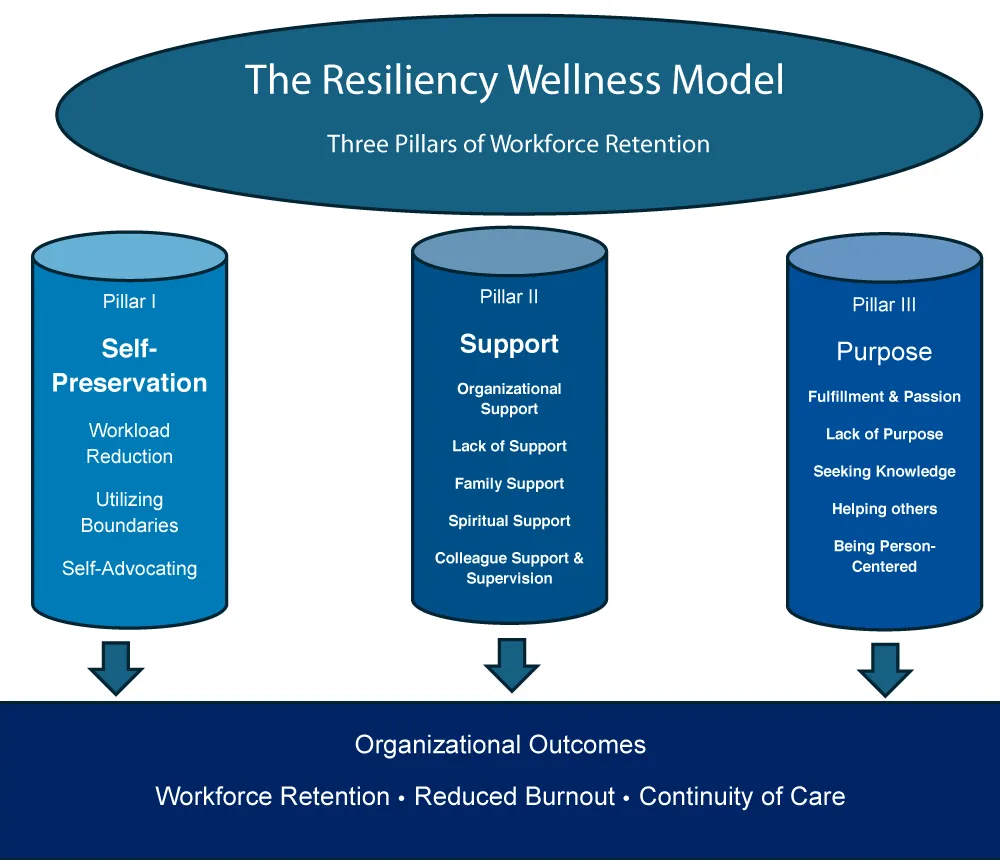
Figure 1: Conceptual diagram.
Self-Preservation
The first major theme identified is self-preservation. The participants engaged in intentional actions to safeguard their physical and emotional limits. This active decision-making process involves utilizing boundaries and advocating for manageable workloads to prevent overwhelming fatigue [24]. Participants described workload reduction as central to this process. Barbara reflected that it was a developmental process of learning “how much I can take and when enough is enough,” while another participant described a more structured approach, carving out dedicated recovery time by “working a half day, one day a week so that I could go play” 25]. A third participant managed the emotional demands of clinical work by restructuring her role, describing how she would “mix up administrative and clinical and throwing in supervision” as a proactive measure against burnout and compassion fatigue [25].
Boundary maintenance emerged as equally central to self-preservation. Sherry described guiding herself and her clients toward emotional separation at the end of a session, noting that while it is important to be fully present with clients, “we have to let it go with them” 25]. Another participant described the shift in perspective that came with practicing boundaries, summarizing it plainly: “Work is work, and I’m not going to let it interfere with my personal life” [25]. Self-advocacy rounded out this theme, with one participant describing how she was able to “voice that I need a minute” and that her colleagues and supervisors “give me that minute that I need” [25]. The authors interpret these accounts as reflecting a pattern of deliberate, sustained self-management rather than reactive coping. The authors view these protective measures as essential components of a sustainable career [26-18]. Organizations often fail to recognize and endorse the necessity of these boundaries.
Support
The second prominent theme centers entirely on support. The clinicians highlighted the absolute necessity of multidimensional networks to buffer against occupational trauma. As Ducharme et al. (2008) [9] point out, receiving backing from colleagues and supervisors is heavily associated with increased well-being and reduced turnover. Participants described organizational support as a meaningful and tangible experience. Rose recalled a supervisor who asked the team directly what they needed and how to make the work sustainable, noting that “he was checking in on us” [25]. This kind of active supervisory care stood in sharp contrast to the lack of support that participants also identified as one of their most significant obstacles. One participant described being placed in demanding clinical roles without adequate preparation, stating that she felt “thrown into positions” with “very little resources, very little training” [25]. Rose described the isolating effect of this absence of understanding, noting that administrators simply “don’t understand what we do” [25]. The authors note that participants did not experience a lack of support as a minor inconvenience but as a primary driver of professional vulnerability.
Despite those obstacles, participants consistently identified supportive relationships that helped sustain them. Colleague support in particular emerged as a long-term protective factor, with Rose describing a peer relationship of over a decade: “I’ve worked with [her] for 10 years who, me and her, well, we’re in this together” [25]. The authors interpret these accounts as consistent with Ducharme et al. (2008) and Rogers et al. (2016) [9,28], who identify peer networks and supervisory backing as structural conditions of sustainability rather than incidental benefits. The protective effect of peer and supervisory support against secondary traumatic stress has also been documented in the clinical literature [29]. This finding serves as a call for agencies to cultivate collaborative alliances. Professional isolation is a primary catalyst for clinical exhaustion and can be mitigated through intentionally applied support [28].
Purpose
The final theme involved the profound impact of purpose. The seasoned professionals maintained a deep intrinsic motivation fueled by a desire to help others heal. The findings solidified that burnout frequently originates from an unmet expectation that the profession will provide deep meaning to the individual [30]. Participants described purpose in ways that acknowledged both its sustaining power and its cost. Sherry captured this tension directly, describing her work as “thrilling and... devastating, and it’s passionate and it’s exhausting,” yet following that with “I absolutely love it” [25]. This capacity to hold difficulty and meaning simultaneously appeared to be a hallmark of the participants who had remained in the field longest.
The pursuit of knowledge also functioned as a form of purposeful engagement. Rose described a continuous internal drive, stating “That’s my drive to constantly seek something” and “This is why I continue to keep going” [25]. For others, purpose was grounded directly in the outcomes of clients. Elizabeth stated, “I continue because I know that people really can do it and get off drugs and alcohol and live a better life” [25]. Being person-centered also contributed to this sense of meaning, with Nancy describing the importance of being able to “see the person behind the substance” [25]. The authors interpret these accounts as consistent with Pines (2004) [30] and note that purpose is not simply an internal trait but one that organizational conditions can either sustain or gradually erode through bureaucratic overload and inadequate recognition. The authors recognize that nurturing this passion is critical for long-term retention. Bureaucratic constraints often erode this fundamental sense of mission, resulting in a compromised workforce [31,32].
The culmination of these three themes creates a descriptive and comprehensive picture of clinical resilience. The data show that longevity requires a balanced integration of personal boundaries, institutional backing, and meaningful work. As Masten (2018)[14] suggests, this combination of factors successfully buffers the clinician against the inherent adversities within healthcare environments. These results support the argument that employers must address all three areas simultaneously. This thematically informed lens guides the authors’ practical recommendations.
The three pillars of the Resiliency Wellness Model, self-preservation, support, and purpose, address distinct dimensions of the clinician’s occupational experience, and the model proposes that organizational outcomes emerge from their combined presence rather than from any single pillar addressed in isolation. Figure 1 illustrates these relationships and the workforce outcomes they are intended to produce.
The model draws conceptually on the Job Demands-Resources (JD-R) framework developed by Bakker and Demerouti (2017) [33], which holds that burnout results from an imbalance between the demands placed on workers and the resources available to meet them. Within that framework, self-preservation corresponds to demand management, specifically the reduction of unnecessary load and the protection of adequate recovery time. Support corresponds to the resource dimension, particularly the social and organizational resources that buffer against the depletion that high-demand work produces. Purpose maps most closely onto what the JD-R model describes as motivational resources: the intrinsic conditions that sustain engagement even when external demands are high.
The model also engages meaningfully with Stamm’s (2010) [16] professional quality-of-life framework, which distinguishes compassion satisfaction from burnout and secondary traumatic stress as separate dimensions of the occupational experience. Self-preservation and support primarily address the risk dimensions of that model, specifically the conditions that allow burnout and secondary trauma to develop unchecked. Purpose maps onto compassion satisfaction, which Stamm (2010) 16] identifies as the protective counterweight most associated with sustained engagement in helping professions. The Resiliency Wellness Model builds on both frameworks by translating their components into a set of organizational priorities that administrators can act on directly, rather than leaving the burden of balance to individual clinicians alone.
What distinguishes these three pillars from related constructs such as self-care, coping, or workload management is their explicitly organizational orientation. Self-care, as typically framed in the literature, is an individual practice. Self-preservation as defined here is both a personal behavior and an organizational responsibility: it requires that agencies create structures, including caseload caps, protected time, and scheduling policies, that make the behavior practically achievable. Similarly, social support as a general construct does not specify who carries responsibility for ensuring its presence. The support pillar in this model places that responsibility with organizational leadership and supervisory structures rather than leaving it to chance or individual initiative. Purpose is distinguished from intrinsic motivation by its vulnerability to structural erosion: participants in this study described not a loss of original motivation but an increasing difficulty accessing that motivation under conditions of administrative overload and inadequate recognition.
The results challenge the traditional notion that burnout is solely an individual failing. Through the lens of Organizational Theory, burnout is a direct consequence of work stressors coupled with inadequate employer resources [34]. Occupational stressors specific to healthcare settings have been shown to accumulate over time, with emotional and physical demands compounding when supervisory resources are absent [35]. This brief provides possible solutions toward systemic reform. It not only argues that organizations must take accountability for the environments they create, but it also provides potential steps for supporting clinicians who care for individuals with mental illness and substance use disorders.
The concept of self-preservation aligns with established coping mechanisms. The ability to reduce workloads and set firm professional limits is a critical indicator of professional confidence. Higher levels of self-efficacy are consistently associated with lower emotional exhaustion among professionals providing therapy [36]. Supervisor support has been found to be a specific predictor of both burnout reduction and therapeutic self-efficacy in clinical settings [37]. This data underscored the urgent need for agencies to respect clinical boundaries. Administrators must actively back clinicians who advocate for their own health [38,39].
The presence of a strong peer network effectively neutralizes the isolating effects of secondary trauma. Supportive leadership practices and peer collaboration significantly increase staff job satisfaction and retention [40-42]. This further serves as proof that team cohesion is not a luxury but a necessity [43,44]. Social support within the clinical workplace has also been shown to reduce feelings of professional isolation among practitioners in training, with positive effects on long-term engagement [45]. Agencies must intentionally design spaces for this collaboration to flourish.
The role of purpose must be considered as the ultimate antidote to professional stagnation. The drive to provide person-centered care sustains energy even in highly demanding environments. Intrinsic motivation and self-efficacy are powerful predictors of compassion satisfaction [46-48]. Clinicians who regularly access a sense of meaning in their work demonstrate greater resistance to burnout, a pattern confirmed across healthcare settings [49]. The authors note how organizations often stifle this passion through excessive administrative burdens. Leaders must acknowledge and actively address these barriers so clinicians can focus on healing and supporting individuals seeking recovery.
In conclusion, for the Resiliency Wellness Model, the three pillars do not operate in isolation but rather reinforce one another. As the research reinforces these notions, true workforce stability requires a holistic approach that meets socioemotional needs while mitigating excessive demands [5,33,50,51]. This report frames this discussion as a call to action for all levels of healthcare management, as the authors prepare to translate these theoretical insights into concrete administrative policies that will ultimately benefit both the practitioners and the individuals they serve.
Implications for Behavioral Health
Specific implications exist for behavioral health infrastructure and management. Implementing the Resiliency Wellness Model requires a fundamental evolution in agency priorities, shifting from a focus on high-volume production to a focus on provider sustainability. High turnover rates incur massive hidden costs related to the constant recruiting and training of new personnel, profoundly disrupting the continuity of clinical care for individuals with substance use disorders [52]. Investing in strategies that help counselors thrive ultimately saves organizations significant financial resources by reducing this turnover [53,10]. Estimates of expenditures attributable to provider burnout and burnout-related turnover reach into the billions of dollars annually across the healthcare sector [54]. The authors propose that administrators view staff wellness and equitable financial compensation as core operational metrics rather than secondary concerns. Adequate financial compensation and fairness in administrative decision-making are critical contextual predictors of reduced clinical exhaustion [55]. By proactively offering competitive salaries, organizations actively demonstrate that they value the immense emotional labor required to support individuals with mental illness.
The priority is institutionalizing self-preservation through comprehensive policies. Treatment centers must actively assist with necessary workload reduction and boundary enforcement. Smaller, more manageable caseloads are directly associated with better client engagement and significantly lower staff exhaustion [56]. Agencies should establish firm caps on weekly clinical hours and provide protected administrative time, ensuring paperwork does not encroach on personal rest and giving clinicians time to decompress [57,58]. Furthermore, the chronic stress of processing trauma requires scheduled periods of total detachment from the clinical environment. Administrators must offer increased, accessible paid time off and actively encourage staff to utilize it without professional penalty, as this is a primary system-level recommendation to reduce exhaustion [59]. Integrating compassion fatigue education into clinical supervision equips both supervisors and trainees with the language and tools to identify emotional depletion before it reaches a critical threshold [60]. Additionally, addiction counselors who encounter suicidal ideation in their caseloads require specialized training, as education and clinical experience alone do not consistently produce confidence in treating suicidal clients [61]. Clinicians who have structural freedom and financial security to rest return to their clinical duties with renewed energy and sharper therapeutic focus.
Next, administrators must outline strategies for facilitating multidimensional support networks within the clinic. Schedules must be designed to allow for regular and meaningful peer interaction. Creating structured group supervision enhances colleague support and fosters essential psychological safety [62]. Additionally, clinical directors are urged to implement formal peer support groups that focus on emotional processing rather than solely on clinical logistics, as shared vulnerability builds profound collective resilience [29]. Implementing these structural enhancements yields a direct and measurable return on investment. When clinicians are supported through ample time off, manageable schedules, and strong peer networks, their overall job satisfaction and daily engagement are directly boosted. Supported clinicians operate with much higher levels of productivity and safety [63]. This dynamic creates a powerful win-win scenario where the agency thrives financially while the provider thrives professionally.
Equally important is addressing the organizational responsibility to nurture intrinsic motivation and purpose [64]. Agencies must foster environments that enable authentic, person-centered care practices, ensuring the focus remains on the individuals receiving services [65]. Recognizing counselor successes and celebrating clinical milestones act as powerful positive reinforcers [66]. Furthermore, organizational leaders are advised to fund ongoing professional development to stimulate intellectual curiosity. Offering continuing education units, while making them free or financially discounted for clinicians, allows practitioners to improve competency and advance their growth. It is vital that bureaucratic demands never overshadow the agency’s fundamental healing mission.
This brief report serves as a catalyst for system-wide retention strategies. The behavioral health field cannot afford to lose another generation of skilled practitioners to preventable burnout [67]. The field has an ethical obligation to prepare and protect its clinical workforce, as advocated for by the Substance Abuse and Mental Health Services Administration [68,69], the American Psychological Association (APA, 2017) [70], the National Association of Social Workers (NASW, 2021) [71], the American Association for Marriage and Family Therapy (AAMFT, 2026) [72], and the National Board for Certified Counselors (NBCC, 2023) [73], among others. The authors encourage all treatment organizations to adopt the Resiliency Wellness Model immediately and unconditionally. With an introspective plan, a commitment to fair compensation, and collaborative support, behavioral health agencies can build a healthier, financially stable future in which dedicated clinicians are consistently supported, and longevity is achievable and appropriately valued.
Declarations
Funding: No funding was received to assist with the preparation of this manuscript.
Competing interests: The authors have no competing interests to declare that are relevant to the content of this article.
Ethics approval: Ethical approval was not required for this conceptual brief report, as no new human participants, data, or biological material were involved. (Note: The foundational phenomenological research study informing this framework was approved by the Liberty University Institutional Review Board, IRB-FY22-23-590).
Consent to participate: Not applicable, as no new human participants were recruited or involved in the preparation of this manuscript.
Data availability: Data sharing is not applicable to this article as no datasets were generated or analyzed during the current study.
Authors’ contribution
The first author contributed to the study conception and design, literature review, and manuscript drafting. Material preparation, data collection, and qualitative analysis of the foundational research were performed by the author. The author read and approved the final manuscript.
- Stelson EA, Sabbath-Clayton LL, Sorensen G, Kubzansky LD, Berkman LF, Sabbath EL. Residential addiction treatment providers: Identifying the role of social context in worker health and turnover. Soc Sci Med. 2022;314:115462. Available from: https://doi.org/10.1016/j.socscimed.2022.115462
- Willard-Grace R, Knox M, Huang B, Hammer H, Kivlahan C, Grumbach K. Burnout and health care workforce turnover. Ann Fam Med. 2019;17(1):36-41. Available from: https://doi.org/10.1370/afm.2338
- Vilardaga R, Luoma JB, Hayes SC, Pistorello J, Levin ME, Hildebrandt MJ, Kohlenberg B, Roget NA, Bond FW. Burnout among the addiction counseling workforce: The components of job burnout and engagement. J Subst Abuse Treat. 2011;41(4):378-88. Available from: https://doi.org/10.1016/j.jsat.2011.05.002
- McCormack HM, MacIntyre TE, O'Shea D, Herring MP, Campbell MJ. The prevalence and cause(s) of burnout among applied psychologists: A systematic review. Frontiers in Psychology. 2018. 9: 1897. Available from: https://doi.org/10.3389/fpsyg.2018.01897
- Edú-Valsania S, Laguía A, Moriano JA. Burnout: A review of theory and measurement. Int J Environ Res Public Health. 2022;19(3):1780. Available from: https://doi.org/10.3390/ijerph19031780
- National Academies of Sciences, Engineering, and Medicine. Taking action against clinician burnout: A systems approach to professional well-being. Washington (DC): National Academies Press; 2019. Available from: https://doi.org/10.17226/25521
- Maslach C. Burnout: The cost of caring. Englewood Cliffs (NJ): Prentice-Hall; 1982.
- Gutierrez D, Butts CM, Lamberson KA, Lassiter PS. Examining the contributions of trait emotional intelligence on addiction counselor burnout. Journal of Addictions & Offender Counseling. 2019; 40(1), 52–64. Available from: https://doi.org/10.1002/jaoc.12056
- Ducharme LJ, Knudsen HK, Roman PM. Emotional exhaustion and turnover intention in human service occupations: The protective role of coworker support. Sociol Spectrum. 2008;28(1):81-104. Available from: https://doi.org/10.1080/02732170701675224
- Knight DK, Landrum B, Becan JE, Flynn PM. Program needs and change orientation: Implications for counselor turnover. J Subst Abuse Treat. 2012;42(2):159-68. Available from: https://doi.org/10.1016/j.jsat.2011.10.019
- Knudsen, H. K., Ducharme, L. J., & Roman, P. M. (2006). Counselor turnover and addiction treatment outcomes: A systemic paradigm. Journal of Substance Abuse Treatment, 30(4), 283–291. https://doi.org/10.1016/j.jsat.2006.01.003
- Li A, Early SF, Mahrer NE, Klaristenfeld JL, Gold JI. Group cohesion and organizational commitment: Protective factors for nurse residents' job satisfaction, compassion fatigue, compassion satisfaction, and burnout. J Prof Nurs. 2014;30(1):89-99. Available from: https://doi.org/10.1016/j.profnurs.2013.04.004
- Stephens JP, Heaphy ED, Carmeli A, Spreitzer GM, Dutton JE. Relationship quality and virtuousness: Emotional carrying capacity as a source of individual and team resilience. J Appl Behav Sci. 2013;49(1):13-41. Available from: https://doi.org/10.1177/0021886312471317
- Masten AS. Resilience theory and research on children and families: Past, present, and promise. J Fam Theory Rev. 2018;10(1):12-31. Available from: https://doi.org/10.1111/jftr.12255
- Aspinwall LG, Taylor SE. Modeling cognitive adaptation: A longitudinal investigation of the impact of individual differences and coping on college adjustment and performance. Journal of Personality and Social Psychology. 1992; 63(6), 989–1003. Available from: https://doi.org/10.1037/0022-3514.63.6.989
- Stamm BH. The ProQOL manual: The professional quality of life scale: Compassion satisfaction, burnout & compassion fatigue/secondary traumatic stress scales. ProQOL.org; 2010.
- Moustakas C. Phenomenological research methods. Thousand Oaks (CA): SAGE Publications; 1994.
- Skovholt TM, Trotter-Mathison M. The resilient practitioner: Burnout and compassion fatigue prevention and self-care strategies for the helping professions. 3rd ed. New York (NY): Routledge; 2016.
- Adams C, van Manen M. Phenomenological inquiry. In: Given LM, editor. The SAGE encyclopedia of qualitative research methods. Thousand Oaks (CA): SAGE Publications; 2008. p. 615-9.
- Creswell JW, Poth CN. Qualitative inquiry and research design: Choosing among five approaches. 4th ed. Thousand Oaks (CA): SAGE Publications; 2018.
- Englander M. General knowledge claims in qualitative research. Hum Psychol. 2019;47(1):1-22. Available from: https://doi.org/10.1037/hum0000107
- Levitt HM, Motulsky SL, Wertz FJ, Morrow SL, Ponterotto JG. Recommendations for designing and reviewing qualitative research in psychology: Promoting methodological integrity. Qual Psychol. 2017;4(1):2-22. Available from: https://doi.org/10.1037%2Fqup0000082
- Southwick SM, Bonanno GA, Masten AS, Panter-Brick C, Yehuda R. Resilience definitions, theory, and challenges: Interdisciplinary perspectives. Eur J Psychotraumatol. 2014;5(1):25338. Available from: https://doi.org/10.3402/ejpt.v5.25338
- Zhang H, Tang L, Ye Z, Zou P, Shao J, Wu M, Zhang J, Mu S, Wang J. The role of boundary setting and workload management in reducing emotional exhaustion among healthcare practitioners. J Adv Nurs. 2021;77(3):1244-55. Available from: https://doi.org/10.1111/jan.14661
- Paulson BN, Hayes AL, Lilley SC, Imhoff BA, Crosland CA. The lived experiences of addiction counselors and applications for building resiliency. Journal of Addiction Therapy and Research. 2024; 8(1), 024–034. Available from: https://doi.org/10.29328/journal.jatr.1001031
- Rapp DJ, Hughey JM, Kreiner GE. Boundary work as a buffer against burnout: Evidence from healthcare workers during the COVID-19 pandemic. J Appl Psychol. 2021;106(8):1169-81. Available from: https://doi.org/10.1037/apl0000951
- Rokach A, Boulazreg S. The COVID-19 era: How therapists can diminish burnout symptoms through self-care. Curr Psychol. 2022;41(8):5660-71. Available from: https://doi.org/10.1007/s12144-020-01149-6
- Rogers E, Polonijo AN, Carpiano RM. Getting by with a little help from friends and colleagues: Testing how residents’ social support networks affect loneliness and burnout. Can Fam Physician. 2016;62(11):677-83.
- Tosone C, McTighe JP, Bauwens J, Naturale A. Shared traumatic stress and the long-term impact of 9/11 on Manhattan clinicians. Journal of Traumatic Stress. 2011; 24(5), 546–552. Available from: https://doi.org/10.1002/jts.20677
- Pines AM. Adult attachment styles and their relation to burnout: A study of help professionals. Work Stress. 2004;18(1):66-80. Available from: https://doi.org/10.1080/02678370410001690508
- Apaydin E. Administrative work and job role beliefs in primary care physicians: An analysis of semi-structured interviews. Sage Open. 2020;10(1). Available from: https://doi.org/10.1177/2158244020914561
- Erickson SM, Rockwern B, Koltov M, McLean RM. Putting patients first by reducing administrative tasks in health care: A position paper of the American College of Physicians. Ann Intern Med. 2017;166(9):659-61. Available from: https://doi.org/10.7326/M16-2697
- Bakker AB, Demerouti E. Job demands-resources theory: Taking stock and looking forward. J Occup Health Psychol. 2017;22(3):273-85. Available from: https://doi.org/10.1037/ocp0000056.
- Hunsaker S, Chen HC, Maughan D, Heaston S. Factors that influence emergency department nurses' burnout during an active shift. J Emerg Nurs. 2015;41(4):316-24. Available from: https://doi.org/10.1016/j.jen.2014.10.019
- Arble E, Arnetz BB. A prospective study of the effects of chronic occupational stress on police officers. International Journal of Environmental Research and Public Health. 2017; 14(10), 1162. Available from: https://doi.org/10.3390/ijerph14101162
- Kim JJ, Brookman-Frazee L, Asarnow JR. Therapist self-efficacy, burnout, and emotional exhaustion in community mental health settings. J Clin Psychol. 2018;74(12):2235-48. Available from: https://doi.org/10.1002/jclp.22685
- Gibson JA, Grey IM, Hastings RP. Supervisor support as a predictor of burnout and therapeutic self-efficacy in therapists working in ABA schools. Journal of Autism and Developmental Disorders. 2009; 39(7), 1024–1030. Available from: https://doi.org/10.1007/s10803-009-0709-4
- De Simone S, Vargas M, Servillo G. Organizational strategies to reduce physician burnout: A systematic review and meta-analysis. Aging Clin Exp Res. 2021;33:883-94. Available from: https://doi.org/10.1007/s40520-020-01633-z
- Shanafelt TD, Noseworthy JH. Executive leadership and physician well-being: Nine organizational strategies to promote engagement and reduce burnout. Mayo Clin Proc. 2017;92(1):129-46. Available from: https://doi.org/10.1016/j.mayocp.2016.10.004
- Broome KM, Knight DK, Edwards JR, Flynn PM. Leadership, burnout, and job satisfaction in outpatient drug-free treatment programs. J Subst Abuse Treat. 2009;37(2):160-70. Available from: https://doi.org/10.1016/j.jsat.2009.01.002
- Laschinger HKS, Borgogni L, Consiglio C, Read E. The effects of authentic leadership, six areas of worklife, and occupational coping self-efficacy on new graduate nurses’ burnout and mental health: A cross-sectional study. Int J Nurs Stud. 2015;52(6):1080-9. Available from: https://doi.org/10.1016/j.ijnurstu.2015.03.002
- Ofei AMA, Paarima Y, Barnes T, Poku CA. Toxic leadership behaviour of nurse managers on perceived job satisfaction and productivity of nursing workforce in sub-Saharan Ghana. J Nurs Manag. 2022;30(7):2733-42. Available from: https://doi.org/10.1111/jonm.13745
- Li A, Early SF, Mahrer NE, Klaristenfeld JL, Gold JI. Group cohesion and organizational commitment: Protective factors for nurse residents' job satisfaction, compassion fatigue, compassion satisfaction, and burnout. Journal of Professional Nursing. 2014; 30(1), 89–99. Available from: https://doi.org/10.1016/j.profnurs.2013.04.004
- Stephens JP, Heaphy ED, Carmeli A, Spreitzer GM, Dutton JE. Relationship quality and virtuousness: Emotional carrying capacity as a source of individual and team resilience. The Journal of Applied Behavioral Science. 2013; 49(1), 13–41. Available from: https://doi.org/10.1177/0021886312471317
- Mikkola L, Suutala E, Parviainen H. Social support in the workplace for physicians in specialization training. Medical Education Online. 2018; 23(1), Article 1433315. Available from: https://doi.org/10.1080/10872981.2018.1433315
- Martin-Cuellar A, Lardier DT Jr, Atencio DJ. Therapist mindfulness and subjective vitality: The role of psychological wellbeing and compassion satisfaction. J Ment Health. 2021;30(1):113-20. Available from: https://doi.org/10.1080/09638237.2019.1677870
- Shoji K, Cieslak R, Smoktunowicz E, Rogala A, Benight CC, Luszczynska A. Associations between job burnout and self-efficacy: A meta-analysis. Anxiety Stress Coping. 2015;29(4):367-86. Available from: https://doi.org/10.1080/10615806.2015.1058367
- Yang C. Online teaching self-efficacy, social–emotional learning (SEL) competencies, and compassion fatigue among educators during the COVID-19 pandemic. Sch Psychol Rev. 2021;50(4):505-18. Available from: https://doi.org/10.1080/2372966X.2021.1903816
- Shanafelt TD. Enhancing meaning in work: A prescription for preventing physician burnout and promoting patient-centered care. JAMA. 2009; 302(12), 1338–1340. Available from: https://doi.org/10.1001/jama.2009.1385
- Lesener T, Gusy B, Wolter C. The job demands-resources model: A meta-analytic review of longitudinal studies. Work Stress. 2018;33(1):76-103. Available from: https://doi.org/10.1080/02678373.2018.1529065
- Paulson B. Exploring Resiliency to Burnout: A Phenomenological Study of Addiction Counselors Resilient to Burnout. Liberty University. 2023. Available from: https://www.proquest.com/openview/61a45f2476de1b7dd4367adb7b9669f8/1?pq-origsite=gscholar&cbl=18750&diss=y
- Eby LT, Burk H, Maher CP. How serious of a problem is staff turnover in substance abuse treatment? A longitudinal study of actual turnover. J Subst Abuse Treat. 2010;39(3):264-71. Available from: https://doi.org/10.1016/j.jsat.2010.06.009
- Han S, Shanafelt TD, Sinsky CA, Awad KM, Dyrbye LN, Fiscus LC, Trockel M, Goh J. Estimating the attributable cost of physician burnout in the United States. Ann Intern Med. 2019;170(11):784-90. Available from: https://doi.org/10.7326/M18-1422
- Sinsky AC, Shanafelt TD, Dyrbye LN, Sabety AH, Carlasare LE, West CP. Health care expenditures attributable to primary care physician overall and burnout-related turnover: A cross-sectional analysis. Mayo Clinic Proceedings. 2022; 97(4), 693–702. Available from: https://doi.org/10.1016/j.mayocp.2021.10.022
- Thompson I, Amatea E, Thompson E. Personal and contextual predictors of mental health counselors' compassion fatigue and burnout. J Ment Health Couns. 2014;36(1):58-77. https://www.academia.edu/download/83320552/personal_and_contextual_predictors_of_mental_health_counselors_E2_80_99_compassion_fatigue_and_burnout.pdf
- Landrum B, Knight DK, Flynn PM. The impact of organizational stress and burnout on client engagement. J Subst Abuse Treat. 2012;42(2):222-30. Available from: https://doi.org/10.1016/j.jsat.2011.08.001
- Chapman J, Wegman M, Thompson M, Barrett M. Impact of proposed core faculty protected time requirements: National survey of emergency medicine faculty on work hours and associated job satisfaction. Ann Emerg Med. 2022;80(4):S96. Available from: https://doi.org/10.1016/j.annemergmed.2022.08.243
- Sinsky C, Colligan L, Li L, Prgomet M, Reynolds S, Goeders L, Westbrook J, Tutty M, Blike G. Allocation of physician time in ambulatory practice: A time and motion study in 4 specialties. Ann Intern Med. 2016;165(11):753-60. Available from: https://doi.org/10.7326/M16-0961
- Beitel M, Oberleitner L, Muthulingam D, Oberleitner D, Madden LM. Experiences of burnout among drug counselors in a large opioid treatment program: A qualitative investigation. Subst Abuse. 2018;39(2):211-7. Available from: https://doi.org/10.1080/08897077.2018.1449051
- Merriman, J. (2015). Enhancing counselor supervision through compassion fatigue education. Journal of Counseling & Development, 93(3), 370–378. https://doi.org/10.1002/jcad.12035
- Fruhbauerova M, Comtois KA. Addiction counselors and suicide: Education and experience do not improve suicide knowledge, beliefs, or confidence in treating suicidal clients. Journal of Substance Abuse Treatment. 2019; 106, 29–34. Available from: https://doi.org/10.1016/j.jsat.2019.08.012
- Liu WL, Chang HJ, Yang JC. Building clinical psychological safety through peer supervision and group dynamics. J Clin Nurs. 2016;25(11-12):1655-64. Available from: https://doi.org/10.1111/jocn.13172
- Shanafelt TD, Goh J, Sinsky C. The business case for investing in physician well-being. JAMA Internal Medicine. 2017; 177(12), 1826–1832. Available from: https://doi.org/10.1001/jamainternmed.2017.4340
- Duffy LA. Sense of purpose, self-efficacy and problem-focused coping as predictors of mental health clinician burnout [dissertation]. Lynchburg (VA): Liberty University; 2022. Available from: https://digitalcommons.liberty.edu/doctoral/3657/
- Locatelli SM, LaVela SL. Professional quality of life of veterans affairs staff and providers in a patient-centered care environment. Health Care Manag. 2015;34(3):246-54. Available from: https://doi.org/10.1097/HCM.0000000000000070
- Phillips SB, Rehfuss MC, Trace SE. Sustaining clinical energy: Strategic organizational milestones and recognition in agency contexts. J Ment Health Couns. 2023;45(2):112-26. Available from: https://doi.org/10.17744/mehc.45.2.03
- Reith TP. Burnout in United States healthcare professionals: A narrative review. Cureus. 2018;10(12):e3681. Available from: https://doi.org/10.7759/cureus.3681
- Substance Abuse and Mental Health Services Administration. Competencies for substance abuse treatment clinical supervisors. Technical Assistance Publication Series 21-A. HHS Publication No. SMA 12-4243. Rockville (MD): SAMHSA; 2013. https://library.samhsa.gov/product/tap-21-competencies-substance-abuse-treatment-clinical-supervisors/sma13-4243
- Substance Abuse and Mental Health Services Administration. (2013b). Report to Congress on the behavioral health workforce. U.S. Department of Health and Human Services. Available from: https://greenlake.extension.wisc.edu/files/2019/03/Green-Lake_April-2019-CWAS-Newsletter.pdf
- American Psychological Association. Ethical principles of psychologists and code of conduct. Washington (DC): APA; 2017. https://www.apa.org/ethics/code
- National Association of Social Workers. Code of ethics of the National Association of Social Workers. Washington (DC): NASW; 2021. https://www.socialworkers.org/About/Ethics/Code-of-Ethics/Code-of-Ethics-English
- American Association for Marriage and Family Therapy. AAMFT code of ethics. Alexandria (VA): AAMFT; 2026. https://www.aamft.org/common/Uploadedfiles/LegalEthics/AAMFTCodeofEthics.pdf
- National Board for Certified Counselors. NBCC code of ethics. Greensboro (NC): NBCC; 2023. https://www.nbcc.org/assets/ethics/nbcccodeofethics.pdf